Every decision you make about your estate, from repairing a roof to planning a new build, depends on good data. Without it, even plans with the best intentions are built on guesswork.
The Department for Education’s 2025 School Estate Management Standards have made it clear that managing your school estate is no longer about short-term fixes or reactive maintenance. To achieve Level 3 (which is the new benchmark for fully effective estate management), schools and trusts must understand, use, and trust their data.
Getting there isn’t just about compliance or efficiency. It’s about creating safe, inspiring, and sustainable environments where children can learn comfortably. Because when you use data well, the benefits go far beyond effective building management, you’re able to shape the spaces where learning happens.
What Does “Data and Digital Transformation” Mean in Estate Management?
When we’re discussing school estates, it’s important to understand that data and digital transformation are much more than spreadsheets or survey reports. They represent the evidence base that helps leaders make informed, defensible decisions about the places where children learn.
That data might include information about a building’s condition, helping you identify where maintenance or refurbishment is needed. It includes capacity and sufficiency, showing whether you have enough space to meet changing pupil numbers. It also covers suitability, helping you understand whether your classrooms and facilities truly support how you deliver the curriculum today.
Other vital datasets relate to compliance, ensuring your estate meets legal and safety obligations, and energy and sustainability, which track how buildings perform against carbon and efficiency goals. Together, these create a full picture of how well your estate supports your mission as an educator.
But simply collecting this information isn’t enough. What matters is how it’s managed, connected, and used. The DfE’s emphasis on digital tools such as reality capture and BIM highlights the need for integrated, live, and accessible systems. In practical terms, that means moving from data stored “somewhere on a spreadsheet” to data that actively drives decision-making.
When done right, this gives you confidence and control. You can see which sites are underperforming, which classrooms are underused, and where investment will make the biggest impact, both financially and educationally.

Why Structured, Accessible, and Unified Data Matters
When information about your estate is structured, accurate, and easy to access, you gain the ability to plan proactively instead of reacting to problems. For many schools, this is the difference between firefighting maintenance issues and strategically shaping the future. But what do we mean by structured, accessible, and unified?
- Structured data means information that’s organised in a consistent format. For example, every site record includes the same fields for condition, capacity, compliance, and energy. This consistency makes it easy to compare sites and generate reports.
- Accessible data means that the right people can easily find, view, and use it when needed. No more information is buried in folders or held by one person.
- Unified data means everything sits in one connected system rather than separate spreadsheets or siloed tools. This gives leaders a single version of the truth across the entire estate.
Using this approach brings a wide range of benefits, such as helping you make the case for funding. A capital bid backed by accurate data on condition, suitability, and capacity has a far stronger chance of success than one built on estimates or outdated figures. Alongside this, structured data ensures accountability and transparency. For example, governors and trustees are able to see the same information as site managers or estate leads, which supports informed challenge, robust oversight, and better governance overall.
Ultimately, this is about enabling leaders to make decisions that directly impact pupils, creating safer, more efficient, and more inspiring learning environments across the estate.
What the DfE Expects from Schools and Trusts
Under the DfE’s 2025 standards, data and digital transformation management are no longer optional add-ons; they’re central to effective estate leadership. They expect all responsible bodies to hold accurate, up-to-date data across key areas such as condition, compliance, suitability, sufficiency, energy, and accessibility.
At Level 3, this information must be live, structured, and routinely used to inform planning, risk management, and capital investment. Schools and trusts should have formal processes in place for gathering and validating data, and clear systems to ensure that information is accessible and actionable across all sites.
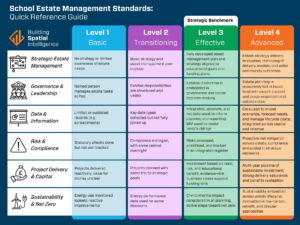
In practice, this means:
- Data must be integrated.
- Reporting must be clear, consistent, and aligned with governance needs.
- Digital models and tools, such as BIM for schools, should be used to visualise and manage assets effectively.
- Estate data should directly inform decisions about maintenance, compliance, and future investment — not sit unused in static reports.
The DfE’s message is simple: every decision about your estate should be rooted in evidence. Reliable data enables responsible bodies to manage risk, justify spending, and demonstrate value for money. But more than that, it ensures that every investment delivers the greatest possible benefit to pupils.
Common Challenges (and How to Overcome Them)
While the benefits of good data are clear, many schools and trusts find themselves held back by the same obstacles. For instance, fragmented systems are one of the most common. Data is often stored in multiple locations, like spreadsheets, paper records, or legacy systems, which makes it difficult to form a complete picture. The solution lies in consolidation and bringing all data together into a single, centralised platform that can be updated and shared across teams.
Outdated information is another frequent issue, and without regular reviews and structured data collection, even the most detailed reports lose their value over time. Setting up regular validation processes helps keep information accurate and dependable.
Many responsible bodies also face limited digital capacity, lacking the tools or expertise to move from manual systems to digital models. Starting small can make a big difference, with digitising floor plans, capacity data, and compliance records laying the foundation for a more advanced, integrated system later on.

Where to Start: Building Better Estate Data
Getting your data in order might sound like a huge task, but small, focused steps can make a big difference. Here’s how estate managers can begin:
- Audit what you already have. Identify what data exists (e.g., condition surveys, compliance logs, floor plans) and where it’s stored.
- Identify gaps and priorities. Look for missing or outdated information that prevents effective planning.
- Standardise your approach. Agree on consistent formats for collecting and recording data so that every site can be compared.
- Choose a central system. Move data from scattered spreadsheets into one digital platform that can be shared across teams.
- Start small and scale up. Begin with your most critical data (like compliance or condition), then build towards a full, integrated dataset over time.
These first steps not only help you meet DfE expectations but also lay the groundwork for smarter, more confident estate management.
Start with a Minimum Viable Dataset (MVDS)
Before aiming for Level 3, schools should establish their Minimum Viable Dataset (MVDS) — the essential information needed to manage the estate effectively. The MVDS typically includes site condition, compliance, capacity, suitability, and accessibility data. It provides a clear, structured starting point for informed decision-making and helps identify immediate priorities.
Many schools aren’t yet at Level 1, so beginning with the MVDS ensures a solid foundation. From here, data collection can expand gradually, integrating additional details and digital tools over time. The MVDS acts as the springboard for moving up through the DfE’s estate management levels, enabling confident planning, efficient investment, and safer, more inspiring learning environments.
Why Reaching Level 3 Matters
Achieving Level 3 in data and digital transformation management is about more than ticking off a list of technical requirements. It’s about unlocking a new level of capability and confidence across your organisation.
At this level, data becomes part of your culture, with leaders relying on it to plan strategically, governors using it to hold decision-makers to account, and estate teams using it to target investment where it has the greatest impact. It allows you to align your estate strategy with your educational mission — ensuring that every decision ultimately supports teaching, learning, and the well-being of pupils.
Schools that reach Level 3 are better positioned to secure funding, manage risk, and plan sustainably. They can forecast future needs, measure progress towards net zero, and make informed choices about where and how to invest.
How Building Spatial Intelligence Can Help
We help schools and trusts turn complex estate data into clear, actionable insights, starting with helping you capture accurate information — from 2D plans and capacity data to full 3D BIM models. We then bring that data together into a single digital platform that gives you visibility across your entire estate. Our dashboards transform complex information into something useful, making it easy for governors, leaders, and estate teams to make informed, timely decisions.
Beyond our tech, we provide strategic guidance, and our team can work with you to interpret the data, identify priorities, and align your estate plans with DfE standards, funding opportunities, and your wider educational goals.
Whether you’re just beginning to digitalise your estate or looking to take the next step toward full integration, we can help you build the capability, structure, and confidence to reach Level 3 and beyond.
Book a free consultation today to find out how we can help your school or trust unlock the power of data and create an estate that truly works for your staff, your community, and above all, your pupils.