A trust board discussing net zero for the first time will, almost without exception, land on solar within the first ten minutes. It’s visible, it’s fundable, and it gives a governor something concrete to point to when the annual report asks what’s actually being done about the estate’s carbon footprint. Insulation, glazing and heating system upgrades tend to get filed under “phase two”, while panels on the roof become the thing that gets built this year.
That instinct holds up. Solar genuinely is one of the faster routes to a lower energy bill and a visible sustainability outcome. The complication tends to sit underneath the decision to install panels, in questions a board rarely thinks to ask before the order goes in. Which roofs can actually take the load. Where the energy being generated will actually get used. Which sites should go first, and on what basis. None of that lives in a solar quote. It lives in the same place any decision about a sustainable estate eventually has to start, in the estate data.
Why Does Solar Keep Winning the First Move?
Solar is easy to commit to because it looks like a single decision: get a quote, get it installed, watch the meter change. What it really depends on is a working picture of the building underneath the panels, and that picture is precisely what most estates teams don’t have in a usable, site-wide form. Roof surveys exist somewhere, structural reports exist somewhere else, and energy consumption data sits in a supplier portal nobody in the estates team has looked at in months.
Getting solar right at scale, across dozens of sites rather than one flagship building, means having that information assembled and comparable before a single installer is instructed. This is the part of the sustainability conversation that rarely makes the board slide, and it’s also the part that determines whether the programme delivers on time or stalls site by site while surveys get commissioned retroactively.
What Does Good Data Add Beyond the Panels?
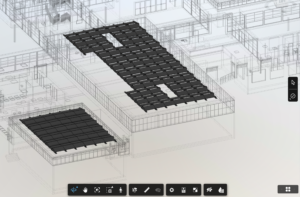
A BIM model built for solar deployment ends up doing considerably more than confirming where the panels can go. Roof condition and structural capacity data tell a trust which sites can take the load without reinforcement, and which will need it costed in before a business case gets signed off. That’s the difference between a solar programme that discovers a structural problem mid-installation and one that’s already priced it in.
Energy use data adds a second layer entirely. Knowing where consumption is actually concentrated across a site, not assumed from a single meter reading, changes how a trust prioritises which buildings get panels first and which get attention elsewhere on the estate. Combined across a multi-academy trust, this turns a list of buildings into a ranked, evidenced sequence of where solar will pay back fastest and where it won’t, which is a considerably easier conversation to have with a finance director than a flat list of every roof on the estate.
What Happens After the Panels Go Up?
Once a trust has that baseline, a digitised estate, structural data, energy consumption mapped by building, the solar programme stops being an isolated project and starts functioning as the foundation for everything that follows. The same model that confirmed roof capacity for panels is the model a trust returns to for glazing upgrades, ventilation work, or a heating system replacement three years later.
This matters more than a nice-to-have from this point forward. The School Estate Management Standards, published by the DfE in April 2025, score a responsible body against six pillars including Data & Information and Sustainability, alongside the underlying Good Estate Management for Schools guidance. Annual SEMS returns begin from Autumn 2026, and a trust walking into that first return with a solar programme’s worth of accurate spatial and energy data behind it starts from a materially stronger position than one filing from memory and old floor plans.
Solar, in other words, isn’t the finish line for a trust’s net zero ambitions. It’s the project that forces the data to exist in the first place, and once it exists, it doesn’t stop being useful when the panels are switched on.
What Does Our DfE-Aligned Self Assessment Tool Tell a Trust?
Everything outlined above, from roof loads and energy mapping to project sequencing, points back to the same starting point. A sustainable estate begins with a trust understanding exactly where it stands against the standard by which it will be assessed, not with its first solar quotation or capital bid. Reaching that level of clarity is harder than it sounds, because many trusts have never evaluated themselves against the DfE framework in a structured way. Instead, they rely on a broad sense that they are either “behind” or “probably fine.”
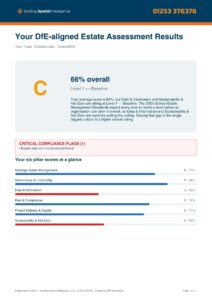
Our self-assessment tool exists to close that gap. It scores a trust against the same six pillars and four maturity levels the DfE itself uses, Baseline, Transitioning, Fully Effective and Advanced, with the same weighting logic behind it. No pillar can outscore a trust’s weakest area, because that’s how the DfE will be assessing overall estate maturity too. The result isn’t a vague impression. It’s a defensible position, the kind that can be put in front of a board or a governor and stand up to the question “how do we know that?”
Download a sample School Estate Health Report
Benchmarking now matters for a reason that has very little to do with sustainability as an abstract ambition. Annual SEMS returns begin from Autumn 2026, and the Academy Trust Handbook already links estate failings to potential Notices to Improve, which makes estate management a board-level responsibility whether a trust has treated it that way before or not. A trust that benchmarks now walks into that first return with evidence already assembled, rather than discovering the gaps while filling in the form.
The assessment returns a downloadable report covering an overall score, a trust’s position on each of the six pillars, and where it sits on the DfE’s maturity model, alongside an action list sequenced by impact. Red flags come first, then the fastest wins toward Level 3, then the longer-term work that lifts maturity beyond it. Every action ties back to a specific DfE standard, so getting from a Baseline score to Level 3 and beyond isn’t a vague aspiration, it’s a sequenced, evidenced route with a clear next step at every stage.
For a sustainability lead trying to work out where their own estate stands before that first return is due, starting the assessment is the most direct way to find out. If a SEMS return is on the horizon, or a solar business case is being built and the data underneath it isn’t quite there yet, we’d be glad to talk it through.