The Education Estates Self Assessment is a free, DfE-aligned tool that benchmarks your school or trust against the School Estate Management Standards (SEMS), Good Estate Management for Schools (GEMS) guidance, and the DfE’s 10-Year Education Estates Strategy.
Get instant access to your report, outlining where you sit on the DfE’s four-level maturity model across all six pillars, and what to fix first.
The assessment scores you against the same six pillars and four maturity levels the DfE uses, so the result reflects how a responsible body would actually be judged. You’ll finish with a clear position on the SEMS maturity model, DfE-aligned actions mapped to each pillar, and a prioritised list of where to focus first to lift your overall score.
Annual SEMS returns begin in Autumn 2026, and every responsible body will need to file one. The DfE has been clear that estate management is now a board-level responsibility, with the Academy Trust Handbook linking estate failings to potential Notices to Improve.
Benchmarking against DfE standards now means you walk into that first return knowing exactly where you stand. The assessment gives you a defensible position to report from, evidence of where the gaps are, and a sequenced plan to reach Level 3: the DfE’s threshold for fully effective estate management.
Acting early turns the deadline into a planning anchor rather than a reporting hurdle.
The DfE’s School Estate Management Standards (SEMS), published in April 2025, set out what good looks like across six areas of estate management. SEMS sits alongside Good Estate Management for Schools (GEMS), the underlying guidance, and the 10-Year Education Estates Strategy, which signals a decade-long shift from reactive repairs to proactive, data-led estate governance.
For academy trusts, single academies, local authority schools and FE colleges, this matters now. The Academy Trust Handbook links estate failings to potential Notices to Improve, and annual returns against SEMS begin from Autumn 2026 via the DfE’s Manage Your Education Estate platform. Boards are expected to show evidence-based decision-making, not just intent.
The tool walks you through a series of questions across the six SEMS pillars. Your answers are scored against the DfE’s four-level maturity model (Baseline, Transitioning, Fully Effective, Advanced), with weightings that mirror SEMS itself. No pillar can outscore its weakest area; the same logic the DfE applies when assessing overall estate maturity.
Each question is grounded in current DfE guidance. Where SEMS sets an expectation, the question is built around it. Where GEMS or the 10-Year Strategy adds detail, the question reflects that too.
You’ll receive a downloadable report covering your overall score, your position on each of the six SEMS pillars, and your standing on the DfE’s four-level maturity model. It gives you a clear, structured view of your current estate management maturity that can support board-level conversations and strategic planning.
The action list is sequenced by impact: red flags first, then the quickest wins towards Level 3, then the longer-term shifts that lift overall maturity. Each action ties back to the relevant DfE standard, so it’s clear what closing the gap involves and where to start.
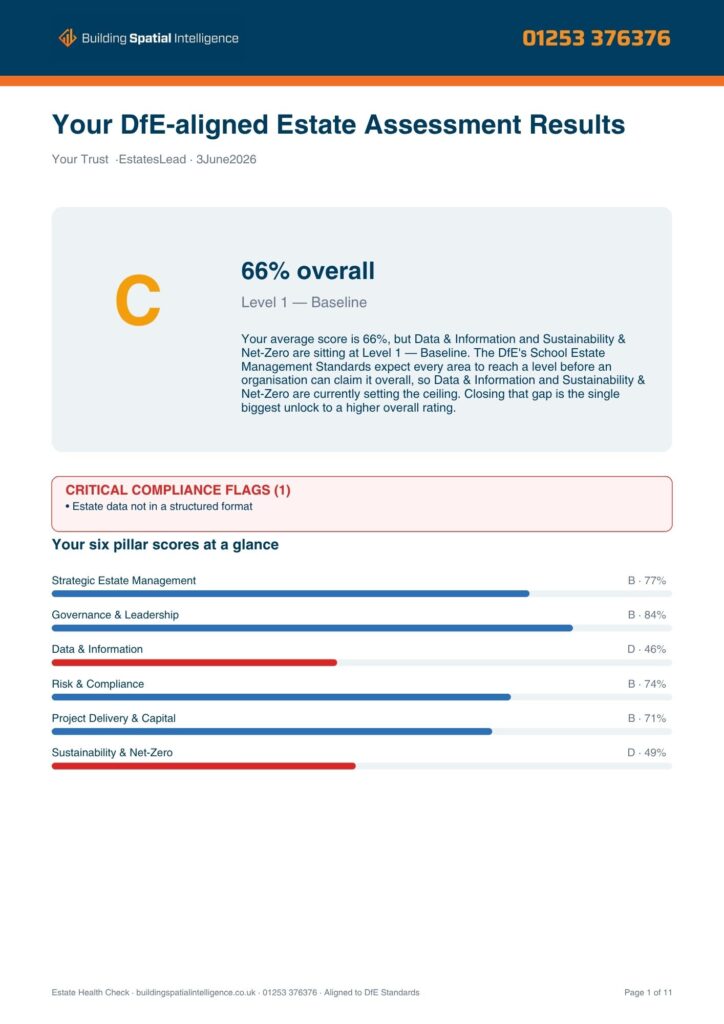
Your completed assessment generates a PDF report giving you an overall score and maturity level across six pillars: Strategic Estate Management, Governance, Data & Information, Risk & Compliance, Project Delivery, and Sustainability.
It flags critical compliance issues, breaks down scored recommendations pillar by pillar distinguishing quick wins from longer-term projects, and shows where you align with the DfE 10-Year Estates Strategy.
Download the sample report to get a clear picture of what you’ll receive when you complete the assessment.
Live classroom temperature readings across monitored school estates. Anonymised, aggregated across all sensors, updated every 5 minutes.