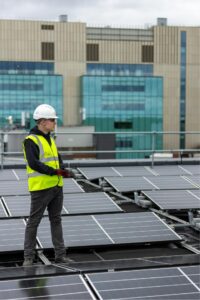
Last week’s announcement from the Department for Energy Security and Net Zero, extending the Great British Energy Solar Partnership to military sites, NHS facilities and more schools, is a significant milestone. At Building Spatial Intelligence, we welcome this expansion, not just as one of the delivery partners supporting schools, but as an opportunity to think bigger about how energy, estates, and education intersect.
The headline numbers are impressive: up to £255 million invested, with around 250 schools, 270 NHS sites and 50 military sites set to benefit. But behind the figures lies a deeper shift: energy infrastructure is no longer an isolated utility upgrade, it’s becoming part of the strategic fabric of the public estate.
More than panels on roofs
Installing solar arrays is not just about cutting energy bills. Done right, it’s about unlocking systemic and operational efficiencies across estates. Schools, hospitals, and military sites are some of the UK’s most complex building portfolios, often ageing, frequently under pressure, and always central to public life. Solar generation, coupled with data-driven estate management, can reshape how these facilities operate:
- Schools can redirect savings into teaching and learning while using renewables as a live educational resource.
- Hospitals can strengthen resilience, lowering overheads in a sector where every pound matters.
- Military sites can decentralise their energy supply, reducing vulnerability and freeing up resources for core defence priorities.
But before embarking on any large-scale solar rollout, there must be a clear, data-backed estate strategy, one that understands the condition, utilisation, and future of every building involved. It’s all well and good investing in solar, but what happens when panels with a 30-year life span are installed on buildings with only 10 years of usable life left in them? That’s not sustainability; it’s short-sightedness.
As a delivery partner, our role goes beyond delivery. We ensure these installations are strategically mapped against building condition, space use, and long-term estate planning.
A solar panel installed without reference to the wider estate strategy is a wasted opportunity; a solar panel integrated into a digital estate model is a future-proofed asset.
Data is the multiplier
The real breakthrough comes when renewable technologies are combined with spatial intelligence and BIM-driven modelling. Imagine a school not only generating its own power, but tracking how that power interacts with its timetable, occupancy, and planned expansions. Or an NHS trust seeing energy generation visualised across all its sites in real time, aligned with condition surveys and investment planning.
This is where Building Spatial Intelligence is helping set the agenda. Our work brings together floor plans, asset registers, condition data, and energy modelling into a single integrated dashboard. For schools, this doesn’t just mean lower bills, it means the ability to forecast, adapt, and plan sustainably for decades.
Beyond energy – towards net zero estates
The government’s announcement rightly highlights job protections and the quality of clean energy work. But equally vital is the way these projects can accelerate the transition to true net zero estates. Solar generation is part of the answer; so too is addressing embodied carbon in new buildings, optimising space use, and ensuring public estates are designed for adaptability.
That’s the challenge, and opportunity, of this moment. The Great British Energy Solar Partnership is a bold investment in infrastructure. But it is also a chance to redefine estate management across education, healthcare, and defence. The question is not only how many panels we install, but how intelligently we integrate them into the long-term future of our public buildings.
At Building Spatial Intelligence, we are proud to be part of this shift. For us, the future of estates is clear: data-driven, strategically planned, and powered by clean energy.