When a school faces an emergency, the difference between control and confusion usually comes down to whether the right people have the right information at the right time, or not. Live occupancy data, predictive maintenance, asset tracking, and structured estate data help schools make faster decisions, protect people, and recover more quickly when something goes wrong.
That matters because school estates rarely fail in neat, predictable ways. A fire alarm might coincide with a timetable change. A flood might hit a plant room before anyone notices a warning sign. A ventilation fault might quietly affect a whole block long before it becomes visible. Data gives schools a way to see what is happening early and to act on it with confidence.
Crisis Planning Depends on Context
A strong emergency plan matters, but a plan on its own doesn’t help much if the building data behind it is incomplete, out of date, or hard to access. Schools need to know who’s on site, which spaces are in use, which assets are critical, and which systems are under pressure before an incident escalates.
This is where structured estate data becomes so important. When information sits inside BIM and connects to asset records, space data, and live readings, it stops being static documentation and starts becoming operational intelligence. For example, if a block loses power, the school can quickly see which rooms are occupied, where the nearest critical equipment sits, and which areas need immediate attention.

Real-Time Occupancy and Environmental Data
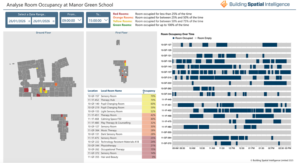
Occupancy data gives schools a clearer picture of how people move through a building, which helps in evacuation, lockdown, and partial closures. Environmental data adds another layer, because it shows whether spaces are safe, comfortable, and functioning as intended. That includes CO2, temperature, humidity, and occupancy, which IoT sensors can measure continuously across classrooms and other spaces.
This kind of live insight matters because it replaces guesswork with evidence. For example, if a classroom starts to overheat or CO2 rises through the morning, staff can respond straight away rather than waiting for a complaint, or a periodic inspection. At that point, the data isn’t just monitoring performance, it’s supporting safer day-to-day operation and better emergency readiness.
Predictive Maintenance Prevents Avoidable Failure
Most crises usually start as faults that stay hidden until they affect safety, access, or continuity. Predictive maintenance helps schools spot those problems earlier by combining inspection history, asset condition, and live sensor data.
For example, repeated temperature spikes in a plant room might point to failing equipment, or a ventilation system that underperforms during busy periods may indicate a deeper issue. When estates teams can see those patterns early, they can plan repairs, reduce disruption, and avoid emergency callouts.
This is also where a structured BIM model matters. It lets the school connect a fault to the right asset, the right room, and the right service history, which makes response faster and more precise.
Asset Tracking Speeds Up Response
In a crisis, time disappears quickly when people don’t know where critical assets are. That applies to isolation points, emergency equipment, plant, shut-off valves, and even the documents and systems needed to recover after an incident. Asset tracking helps staff move faster because it turns the estate into something they can navigate with confidence.
If a fire breaks out in one part of a building, staff need to know where the nearest extinguisher sits, where safe exit routes lead, and which equipment they may need to isolate. If that information lives inside a structured BIM model and connects to facilities management systems, teams can reach it faster and act with more certainty.

Scenario Planning Becomes More Realistic
In turn with the above, emergency planning works best when it reflects the estate as it actually exists. Generic drills teach broad principles, but data-led scenario planning helps schools rehearse the specific conditions they are likely to face.
The more accurate the data, the more useful the exercise. For example, if a school knows which rooms are usually busy at particular times, where vulnerable equipment sits, and which routes stay open under pressure, it can build a much more realistic scenario. That makes tabletop exercises and live drills more meaningful because staff practise decisions based on actual building behaviour, not assumptions.
This is also where BIM adds value beyond design or records. It gives schools a spatial framework they can use to test what happens if a system fails, a zone is isolated, or a building becomes partly unusable. Instead of treating the model as a finished product, the school uses it as a planning tool.

Why Integrated Data Matters
The real value comes when BIM, IoT, asset data, and facilities management work together. BIM gives the estate its structure, IoT sensors give it live environmental readings, asset management gives it operational context, and integrated dashboards bring all of that into one place so teams can see what is happening without switching between disconnected systems.
That matters because crisis readiness depends on clarity. If the right people can see room-level performance, asset location, and live environmental conditions in one view, they can make better decisions under pressure. That isn’t about more data for its own sake, it’s about making the estate easier to understand when the stakes are highest.
What This Changes For Schools
When schools use data well, they move from reactive management to prepared management. They can spot problems earlier, train staff more effectively, and respond with a clearer understanding of the building in front of them. They also build a stronger case for investment, because the data shows where risk sits and how the estate behaves over time.
For schools and trusts, that creates a more resilient estate and a safer environment for pupils and staff. The goal is not technology for its own sake. It’s to make sure the building supports the people inside it, especially when things go wrong.
If you’re looking at how to make your school estate safer, smarter, and easier to manage in a crisis, the first step is getting the data right – book your free consultation today to start the conversation.