
Environmental monitoring for school estates
Know what your buildings are doing right now.
A condition survey tells you what a room was like on the day a surveyor stood in it. Live Estate Monitoring tells you what it is like today, and keeps telling you, without anyone collecting, uploading or re-surveying anything.
Air quality, temperature and movement, room by room, feeding the estate record you already hold. Not a separate sensor dashboard: the same floor plans, the same asset data, the same model, now telling you what is happening inside those spaces today.
Most estate data describes a building as it was, not as it is
Responsible bodies are asked to make decisions about buildings they often have a limited understanding of. Which rooms overheat, which are poorly ventilated, which stand empty while being heated and cleaned: the answers usually come from complaints, spot checks and whoever happens to mention it. None of that survives contact with a funding case.
It’s not only a comfort question. A room sitting above the ventilation guideline is a room where concentration measurably drops, which makes air quality a teaching and wellbeing issue as much as an estates one.
As funding moves towards data-driven allocation, an annual estate return built on anecdote will not hold. Monitoring turns the condition of your estate into something you can evidence rather than assert.
1,140 ppm
Mean classroom CO₂ in 2024/25, up from 1,010 ppm the year before.
1 in 4
Monitors recorded a daily average above the 1,500 ppm guideline during cooler periods.
15%
Lower cognitive scores measured at raised CO₂, against a well-ventilated baseline. A room above 1,500 ppm is well past that point.
A temperature reading on its own tells you very little
The value is in everything sitting around it.
01
Where it is
The reading belongs to a room on a floor plan, with its timetable, heating zone and construction type behind it, so you can see whether a breach lands in teaching time.
02
Who it affects
Movement data and timetables show who is in that room and for how long. Above the CO₂ guideline, pupils work measurably slower and score lower in tests.
03
How often it happens
One hot afternoon is weather. The same room breaching every afternoon from April is a building problem, and only continuous data tells the two apart.
04
What to do about it
Set against that room’s condition, capacity and asset data, you can see whether the answer is ventilation, a timetable change, plant, or a line in the capital plan.
A sensor on its own tells you a room is too hot. These four answers enable you to fix it.
What we monitor
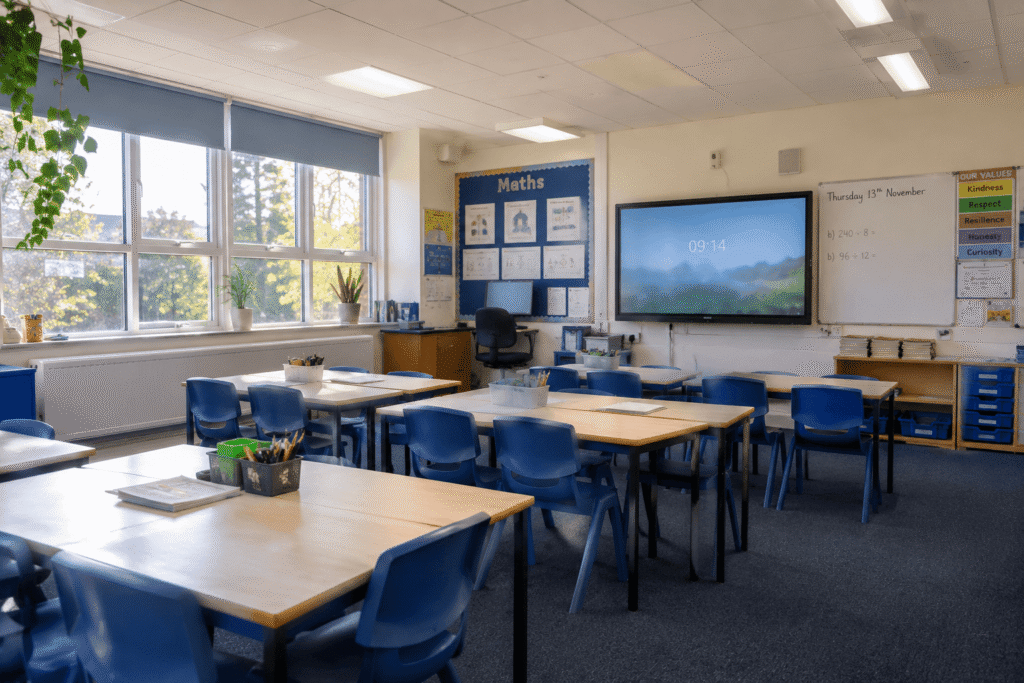

Air Quality and Temperature
CO₂, temperature, humidity and barometric pressure, room by room. Shows you where conditions breach comfort and ventilation standards, when, and for how long.
Explore air quality and temperature →
Movement and Activity
Which spaces are actually used, when, and how often. Shows you rooms standing empty, out-of-hours activity, and space you are heating and cleaning for nobody.
Explore movement and activity →
How it works
No cabling and no power works
Sensors are fixed in place without drilling or wiring. Installation is quick and causes minimal disruption to the school day.
Nothing on your network
Sensors never join the school's Wi-Fi. They report over their own low-power radio to a single on-site connector.
Sensors are easily re-deployed
Nothing is permanently fixed, so a sensor can be redeployed to another room or building as priorities change.
Live temperature, CO₂, humidity, pressure and occupancy
Each reading is tied to its space and is delivered live, so you see your estate as it stands today.
Installed, maintained and supported by Building Spatial Intelligence
Years between visits, with no maintenance programme for your team to run.
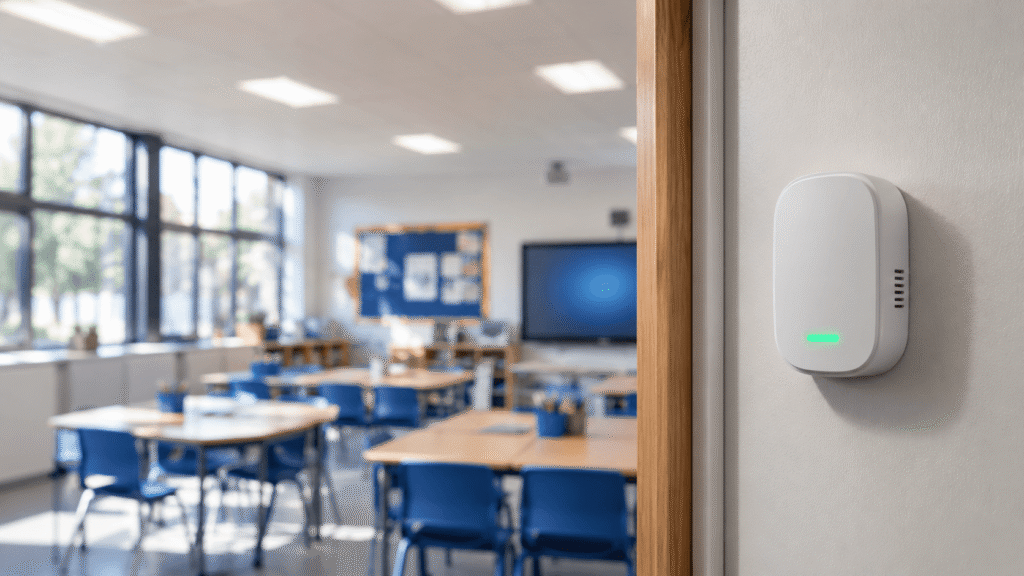
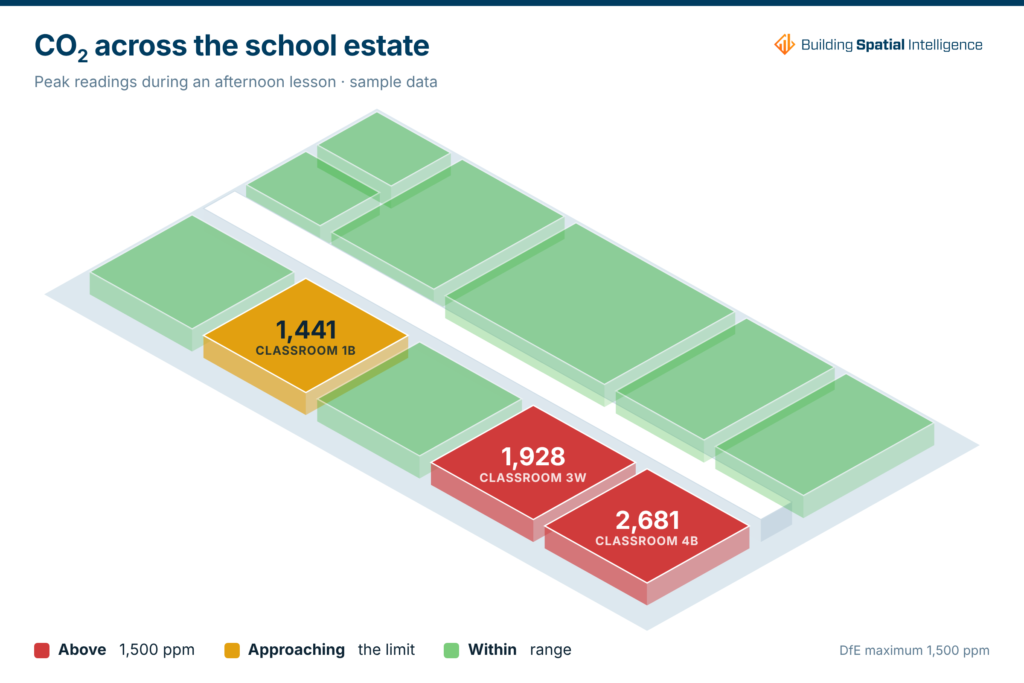
Readings mapped to the room, not just the sensor
Most monitoring gives you a dashboard of sensors. We put the reading in the room.
Every sensor is mapped to its space in your 3D BIM model, so a reading sits alongside that room’s condition data, its capacity, its asset register and its place on the floor plan. There is no second system to reconcile and no exporting one dataset to hold against another. It’s one estate record that keeps itself current.
Other monitoring can tell you a sensor read 29°C. Yours tells you which room, in which building, used by whom, how often it happens, and what it would take to fix.
Inside your dashboard
Monitoring appears as a tab within your existing Building Spatial Intelligence dashboards, next to floor plans, BIM, asset, capacity and energy data.


Get started with Live Estate Monitoring
See what your buildings are actually doing, room by room. Air quality, temperature and movement, mapped to the spaces they came from and sitting alongside the floor plans, condition data and capacity figures you already hold.
Ready to see your estate as it is today?
Frequently Asked Questions About Live Estate Monitoring
Environmental monitoring measures conditions inside buildings continuously, rather than at the moment of a survey, using small wireless sensors. Building Spatial Intelligence’s Live Estate Monitoring covers air quality, temperature and humidity, and adds movement to show how spaces are used. Readings are mapped to individual rooms in a digital model of the estate, so conditions can be seen alongside each space’s condition data, capacity and asset record.
Air quality (carbon dioxide), temperature, humidity and barometric pressure, plus movement to show how spaces are used. Carbon dioxide indicates how well a room is ventilated. Movement shows which rooms are in use, when and how often.
A condition survey records what a building was like on the day it was inspected. Monitoring records what it is like now, and keeps recording. Surveys remain the right tool for fabric and asset condition. Monitoring answers questions a survey cannot, such as how often a classroom overheats or whether a room is used at all.
No. Sensors communicate over their own low-power radio to a single on-site connector. Nothing joins the school’s Wi-Fi and no school IT involvement is needed to run it.
No. Sensors are fixed in place without drilling, cabling or power works, so installation is quick and can be done around the school day.
No. Movement sensors detect that a space is in use. They do not identify people, count them or record images, and they hold no personal data.
The responsible body does. The readings belong to the trust or school, are exportable, and are not locked to Building Spatial Intelligence.
Yes, and that is much of the point. As funding moves towards data-driven allocation, continuous evidence of how buildings perform is more defensible than periodic observation, and it attaches directly to the spaces it describes.
